Energy is such a critical resource — it affects every single human endeavor.
Because it’s become so cheap and readily available, each and every one of us uses more energy than the previous generations.
From wood to whale oil, coal, and oil, every transition has given us access to cheaper energy and has created vast amounts of new wealth for us.
And we’re undergoing another transition right now.
Renewable energy is on the rise. And it’s becoming more important with every passing day. A hundred years ago, people would have laughed if you told them that by 2017 coal would be going the way of the dodo bird.
But it is.
And oil might not be far behind it.
Great emphasis has been put on renewable energy sources over the past few years as people are calling for more sustainable and environmentally sound sources of energy.
And renewable energy has answered this call.
In more ways than one…
Wind
Oil and gas have been whipsawed for the past few years from highs of $140 a barrel to lows of $26 a barrel in February of 2016. Rearguard OPEC cuts will drive prices higher for a time, but over the long term, fracking and renewables will send hydrocarbons to the land of buggy whips and spermaceti.
Many countries are pledging to move away from fossil fuels and instead toward more environmentally safe renewables.

The Paris climate accord in December of 2015 saw 195 countries come together and agree to limit fossil fuel use and also to try moving toward a more environmentally friendly energy future.
The U.S., specifically, has put certain energy restrictions in place. The Wall Street Journal writes:
Utilities are often willing to pay higher prices for wind and solar power because they need the electricity to comply with state rules. The Obama administration also introduced rules last year that require power plants to cut carbon dioxide emissions by 32% from 2005 levels by 2030.
Grid Parity
In addition to governmental restrictions on fossil fuels, renewable energy is also getting cheaper, and people are rapidly turning to it.
Bloomberg New Energy released a report about renewable energy, saying:
2015 produced a new record for global investment in renewable energy. The amount of money committed to renewables excluding large hydro-electric projects rose 5% to $285.9 billion, exceeding the previous record of $278.5 billion achieved in 2011.
Even more striking was that the amount of generating capacity added in wind and solar last year came to 118GW.
Price Drop
Wind energy prices are dropping, while interest is rising. According to the Wall Street Journal:
U.S. wind-power generation has more than doubled over the past five years thanks to new wind farms, and accounted for about 200 million megawatt-hours of electricity in 2015, nearly 5% of the nation’s total power supply… Wind-power prices are down 57% from 2010 to an average of $29 a megawatt-hour.
Wind power is something that’s easy to harness and is a completely free source of energy (once turbines are in place). It’s surprising that it took this long for people to realize that wind power could be so easily harnessed. But now that people realize just how affordable and energy efficient it is, you can be sure that they won’t forget about it.
Solar
Solar roof panels used to be an unusual sight. But lately, it seems like every third house has them installed. Why the boost in panels? They’re finally becoming affordable for the average person.

According to Marlene Motyka, a U.S. alternative energy leader at Deloitte, in a National Geographic article: “Despite low natural gas prices, solar and wind accounted for 60 percent of new U.S. power capacity last year and will likely account for 70 percent this year.”
This is because it’s cheaper. The average price of the PV panel needed for solar installation has decreased more than 50% in price since 2004. There are also government incentives to consider. Congress renewed tax credits on solar and wind power for another five years last year, forcing companies to look into renewable energy sources more seriously as they can help cut costs.
According to the Solar Energy Industries Association (SEIA):
Growing 43 percent year over year, the U.S. saw 2,051 megawatts (MW) of solar photovoltaic (PV) installed in the second quarter of 2016. According to GTM Research and the Solar Energy Industries Association’s (SEIA) latest U.S. Solar Market Insight report, this marks the eleventh consecutive quarter in which more than a gigawatt (GW) of PV was installed.

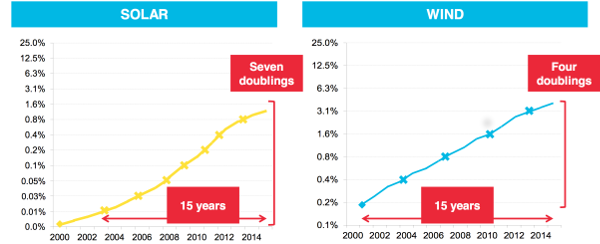
You can see the growth in solar just from the chart above.
While you may think the billions being poured into solar are all from renewable or green companies, some oil and natural gas companies are trying to keep their fingers in every pie and to invest in solar, as well. According to the Guardian:
Total made its first real drive into renewable energy five years ago, with its $1.4bn acquisition of SunPower, one of the largest solar panel makers in the US. Total has also since set up a division, called New Energies, for these low-carbon technologies.
Total is one of the biggest oil and gas companies in the world. Shell has also established a New Energies section that is going to focus on renewable sources of energy. Even Exxon, one of the companies seemingly least likely to bother with energy sources other than fossil fuels, has started looking more seriously into renewable sources of energy.
According to the Nasdaq Stock Market website:
The U.S. installed more solar than natural gas capacity last year, its first in history. According to a current report by GTM Research, U.S. solar installations grew 17% in 2015 to 7,286 megawatts (MW), marking the 15th consecutive annual record. Per the Solar Energy Association, in the next two years, approximately 20,000 MWs of new solar capacity will be installed, about twice the existing capacity.
Solar Power for China
When I think of China, I think of smog.
I think of needing oxygen just to step outside and a world in a gray haze.

I don’t think of renewable energy.
Yet, the truth is that China is actually pouring tons of money into renewable power. In 2016, it put $1.9 billion into renewable energy. Compare that to the $1 billion that the U.S. is investing in the sector.
And while solar panels are providing the energy that China desperately needs, they also take up huge amounts of land — something China can’t afford to give up so easily.
China has the largest population in the world, with 21% of the entire world’s population (1.2 billion) living in the country. And overpopulation has been a problem for years.
What’s China’s solution?
Well, we may start seeing the country using solar panels at an unlikely place.
Recently, China just turned on the largest floating solar plant in the world.
It’s kind of a no-brainer. After all, 71% of the earth’s surface is water, and floating solar panels don’t take up valuable land space in a world that is quickly becoming overpopulated.

The floating power plant has an output of 40 MW. By comparison, wind turbines can produce about 2–3 MW each (if the wind were really blowing).
China doubled its solar capacity in 2016, with 77.42 GW of power available, and with its solar plants generating more than 66 billion hours of power.
And because of the country’s plan to put $365 billion into renewable energy over the next three years, it’s only a matter of time before we see even more growth.
Solar power’s time in the sun is coming.
But surprisingly, China may be leading the charge…
Hydroelectric Power
In 2015 it accounted for 17% of the world’s electricity. It’s expected to grow at a rate of 3% for the next 25 years…
That’s right, I’m talking about hydroelectric power.
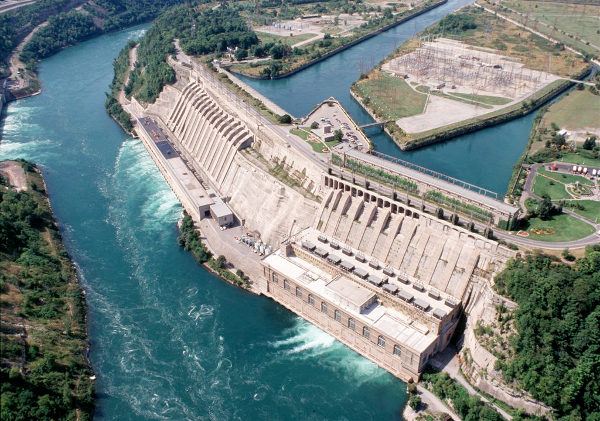
It’s one of the longest-used renewable energy sources.

Since 2014 other renewables have beat out hydroelectric power generation, but this doesn’t mean that it’s no longer important. The EIA reports: “In 2016, hydropower accounted for about 6.5% of total U.S. utility-scale electricity generation and 44% of total utility-scale electricity generation from all renewable energy.”
Hydroelectric power has low operating costs and the technology is fairly simple. A dam with a turbine, that then converts water flow into an electrical current. The power can come from small rivers, or from huge dams, and the dams once built can last over a hundred years and just need maintenance to stay relevant.
It’s more difficult to invest in because it stays more static and doesn’t have the upkeep or technology needs of solar panels, or wind turbines, but it’s still an important part of renewable energy that investors should be aware of.
One comment
Hi, this is a comment.
To get started with moderating, editing, and deleting comments, please visit the Comments screen in the dashboard.
Commenter avatars come from Gravatar.